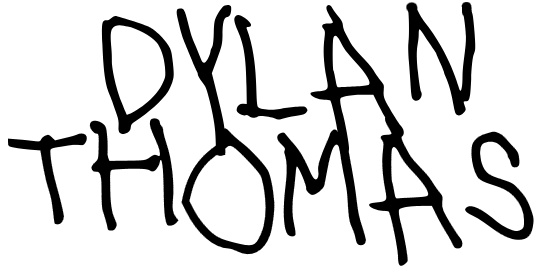
Laugharne: Recorded on October 5th 1953

‘Laugharne’ is Dylan Thomas’ last radio broadcast: Recorded on October 5th 1953 for Aneirin Talfan Davies for the BBC’s Welsh Home Service and broadcast on November 5th 1953 (the day Thomas became gravely ill in New York).

“Off and on, up and down, high and dry, man and boy, I’ve
been living now for fifteen years, or centuries, in this
timeless, beautiful, barmy (both spellings) town, in this far,
forgetful, important place of herons, cormorants (known
here as billyduckers), castle, churchyard, gulls, ghosts,
geese, feuds, scares, scandals, cherry-trees, mysteries,
jackdaws in the chimneys, bats in the belfry, skeletons in
the cupboards, pubs, mud, cockles, flatfish, curlews, rain.
and human, often all too human, beings; and, though still
very much a foreigner, I am hardly ever stoned in the
streets any more, and can claim to be able to call several
of the inhabitants, and a few of the herons, by their
Christian names.
Continue reading

A Refusal to Mourn the Death, by Fire, of a Child in London by Dylan Thomas

A Refusal to Mourn the Death, by Fire, of a Child in London

Never until the mankind making
Bird beast and flower
Fathering and all humbling darkness
Tells with silence the last light breaking
And the still hour
Is come of the sea tumbling in harness

And I must enter again the round
Zion of the water bead
And the synagogue of the ear of corn
Shall I let pray the shadow of a sound
Or sow my salt seed
In the least valley of sackcloth to mourn

The majesty and burning of the child’s death.
I shall not murder
The mankind of her going with a grave truth
Nor blaspheme down the stations of the breath
With any further
Elegy of innocence and youth.

Deep with the first dead lies London’s daughter,
Robed in the long friends,
The grains beyond age, the dark veins of her mother,
Secret by the unmourning water
Of the riding Thames.
After the first death, there is no other.

The force that through the green fuse drives the flower by Dylan Thomas

The force that through the green fuse drives the flower

The force that through the green fuse drives the flower
Drives my green age; that blasts the roots of trees
Is my destroyer.
And I am dumb to tell the crooked rose
My youth is bent by the same wintry fever.

The force that drives the water through the rocks
Drives my red blood; that dries the mouthing streams
Turns mine to wax.
And I am dumb to mouth unto my veins
How at the mountain spring the same mouth sucks.

The hand that whirls the water in the pool
Stirs the quicksand; that ropes the blowing wind
Hauls my shroud sail.
And I am dumb to tell the hanging man
How of my clay is made the hangman’s lime.

The lips of time leech to the fountain head;
Love drips and gathers, but the fallen blood
Shall calm her sores.
And I am dumb to tell a weather’s wind
How time has ticked a heaven round the stars.

And I am dumb to tell the lover’s tomb
How at my sheet goes the same crooked worm.

And death shall have no dominion by Dylan Thomas

And death shall have no dominion

And death shall have no dominion.
Dead men naked they shall be one
With the man in the wind and the west moon;
When their bones are picked clean and the clean bones gone,
They shall have stars at elbow and foot;
Though they go mad they shall be sane,
Though they sink through the sea they shall rise again;
Though lovers be lost love shall not;
And death shall have no dominion.

And death shall have no dominion.
Under the windings of the sea
They lying long shall not die windily;
Twisting on racks when sinews give way,
Strapped to a wheel, yet they shall not break;
Faith in their hands shall snap in two,
And the unicorn evils run them through;
Split all ends up they shan’t crack;
And death shall have no dominion.

And death shall have no dominion.
No more may gulls cry at their ears
Or waves break loud on the seashores;
Where blew a flower may a flower no more
Lift its head to the blows of the rain;
Though they be mad and dead as nails,
Heads of the characters hammer through daisies;
Break in the sun till the sun breaks down,
And death shall have no dominion.

In my Craft or Sullen Art by Dylan Thomas

In my Craft or Sullen Art

In my craft or sullen art
Exercised in the still night
When only the moon rages
And the lovers lie abed
With all their griefs in their arms,
I labour by singing light
Not for ambition or bread
Or the strut and trade of charms
On the ivory stages
But for the common wages
Of their most secret heart.

Not for the proud man apart
From the raging moon I write
On these spindrift pages
Nor for the towering dead
With their nightingales and psalms
But for the lovers, their arms
Round the griefs of the ages,
Who pay no praise or wages
Nor heed my craft or art.

Fern Hill by Dylan Thomas

Fern Hill

Now as I was young and easy under the apple boughs
About the lilting house and happy as the grass was green,
The night above the dingle starry,
Time let me hail and climb
Golden in the heydays of his eyes,
And honoured among wagons I was prince of the apple towns
And once below a time I lordly had the trees and leaves
Trail with daisies and barley
Down the rivers of the windfall light.

And as I was green and carefree, famous among the barns
About the happy yard and singing as the farm was home,
In the sun that is young once only,
Time let me play and be
Golden in the mercy of his means,
And green and golden I was huntsman and herdsman, the calves
Sang to my horn, the foxes on the hills barked clear and cold,
And the sabbath rang slowly
In the pebbles of the holy streams.

All the sun long it was running, it was lovely, the hay
Fields high as the house, the tunes from the chimneys, it was air
And playing, lovely and watery
And fire green as grass.
And nightly under the simple stars
As I rode to sleep the owls were bearing the farm away,
All the moon long I heard, blessed among stables, the nightjars
Flying with the ricks, and the horses
Flashing into the dark.

And then to awake, and the farm, like a wanderer white
With the dew, come back, the cock on his shoulder: it was all
Shining, it was Adam and maiden,
The sky gathered again
And the sun grew round that very day.
So it must have been after the birth of the simple light
In the first, spinning place, the spellbound horses walking warm
Out of the whinnying green stable
On to the fields of praise.

And honoured among foxes and pheasants by the gay house
Under the new made clouds and happy as the heart was long,
In the sun born over and over,
I ran my heedless ways,
My wishes raced through the house high hay
And nothing I cared, at my sky blue trades, that time allows
In all his tuneful turning so few and such morning songs
Before the children green and golden
Follow him out of grace.

Nothing I cared, in the lamb white days, that time would take me
Up to the swallow thronged loft by the shadow of my hand,
In the moon that is always rising,
Nor that riding to sleep
I should hear him fly with the high fields
And wake to the farm forever fled from the childless land.
Oh as I was young and easy in the mercy of his means,
Time held me green and dying
Though I sang in my chains like the sea.

Collected Poems, 1934-1952

Title:      Collected Poems, 1934-1952
Author:     Dylan Thomas (1914-1953)

To Caitlin

Note

The prologue in verse, written for this collected edition of my
poems, is intended as an address to my readers, the strangers.

This book contains most of the poems I have written, and all, up
to the present year, that I wish to preserve. Some of them I have
revised a little, but if I went on revising everything that I now do
not like in this book I should be so busy that I would have no time
to try to write new poems.

I read somewhere of a shepherd who, when asked why he made, from
within fairy rings, ritual observances to the moon to protect his
flocks, replied: ‘I’d be a damn’ fool if I didn’t!’ These poems, with
all their crudities, doubts, and confusions, are written for the love
of Man and in praise of God, and I’d be a damn’ fool if they weren’t.

November 1952.

Author’s Prologue

This day winding down now
At God speeded summer’s end
In the torrent salmon sun,
In my seashaken house
On a breakneck of rocks
Tangled with chirrup and fruit,
Froth, flute, fin, and quill
At a wood’s dancing hoof,
By scummed, starfish sands
With their fishwife cross
Gulls, pipers, cockles, and sails,
Out there, crow black, men
Tackled with clouds, who kneel
To the sunset nets,
Geese nearly in heaven, boys
Stabbing, and herons, and shells
That speak seven seas,
Eternal waters away
From the cities of nine
Days’ night whose towers will catch
In the religious wind
Like stalks of tall, dry straw,
At poor peace I sing
To you strangers (though song
Is a burning and crested act,
The fire of birds in
The world’s turning wood,
For my swan, splay sounds),
Out of these seathumbed leaves
That will fly and fall
Like leaves of trees and as soon
Crumble and undie
Into the dogdayed night.
Seaward the salmon, sucked sun slips,
And the dumb swans drub blue
My dabbed bay’s dusk, as I hack
This rumpus of shapes
For you to know
How I, a spining man,
Glory also this star, bird
Roared, sea born, man torn, blood blest.
Hark: I trumpet the place,
From fish to jumping hill! Look:
I build my bellowing ark
To the best of my love
As the flood begins,
Out of the fountainhead
Of fear, rage read, manalive,
Molten and mountainous to stream
Over the wound asleep
Sheep white hollow farms

To Wales in my arms.
Hoo, there, in castle keep,
You king singsong owls, who moonbeam
The flickering runs and dive
The dingle furred deer dead!
Huloo, on plumbed bryns,
O my ruffled ring dove
In the hooting, nearly dark
With Welsh and reverent rook,
Coo rooning the woods’ praise,
Who moons her blue notes from her nest
Down to the curlew herd!
Ho, hullaballoing clan
Agape, with woe
In your beaks, on the gabbing capes!
Heigh, on horseback hill, jack
Whisking hare! who
Hears, there, this fox light, my flood ship’s
Clangour as I hew and smite
(A clash of anvils for my
Hubbub and fiddle, this tune
On a tounged puffball)
But animals thick as theives
On God’s rough tumbling grounds
(Hail to His beasthood!).
Beasts who sleep good and thin,
Hist, in hogback woods! The haystacked
Hollow farms in a throng
Of waters cluck and cling,
And barnroofs cockcrow war!
O kingdom of neighbors finned
Felled and quilled, flash to my patch
Work ark and the moonshine
Drinking Noah of the bay,
With pelt, and scale, and fleece:
Only the drowned deep bells
Of sheep and churches noise
Poor peace as the sun sets
And dark shoals every holy field.
We will ride out alone, and then,
Under the stars of Wales,
Cry, Multiudes of arks! Across
The water lidded lands,
Manned with their loves they’ll move,
Like wooden islands, hill to hill.
Huloo, my prowed dove with a flute!
Ahoy, old, sea-legged fox,
Tom tit and Dai mouse!
My ark sings in the sun
At God speeded summer’s end
And the flood flowers now.

Continue reading

A Child’s Christmas in Wales

A Child’s Christmas in Wales
by
Dylan Thomas

One Christmas was so much like the other, in those years around the sea-town corner now, out of all sound except the distant speaking of the voices I sometimes hear a moment before sleep, that I can never remember whether it snowed for six days and six nights when I was twelve, or whether it snowed for twelve days and twelve nights when I was six.

All the Christmases roll down towards the two-tongued sea, like a cold and headlong moon bundling down the sky that was our street; and they stop at the rim of the ice-edged, fish-freezing waves, and I plunge my hands in the snow and bring out whatever I can find. In goes my hand into that wool-white bell-tongued ball of holidays resting at the rim of the carol-singing sea, and out come Mrs. Prothero and the firemen.

It was on the afternoon of the day of Christmas Eve, and I was in Mrs. Prothero’s garden, waiting for cats, with her son Jim. It was snowing. It was always snowing at Christmas. December, in my memory, is white as Lapland, although there were no reindeers. But there were cats. Patient, cold and callous, our hands wrapped in socks, we waited to snowball the cats. Sleek and long as jaguars and horrible-whiskered, spitting and snarling, they would slide and sidle over the white back-garden walls, and the lynx-eyed hunters, Jim and I, fur-capped and moccasined trappers from Hudson Bay, off Mumbles Road, would hurl our deadly snowballs at the green of their eyes.
Continue reading

Under Milk Wood

Under Milk Wood
A Play for Voices
by
Dylan Thomas

First published 1954

UNDER MILK WOOD

[Silence]

FIRST VOICE (Very softly)

To begin at the beginning:

It is spring, moonless night in the small town, starless
and bible-black, the cobblestreets silent and the hunched,
courters’-and-rabbits’ wood limping invisible down to the
sloeblack, slow, black, crowblack, fishingboatbobbing sea.
The houses are blind as moles (though moles see fine to-night
in the snouting, velvet dingles) or blind as Captain Cat
there in the muffled middle by the pump and the town clock,
the shops in mourning, the Welfare Hall in widows’ weeds.
And all the people of the lulled and dumbfound town are
sleeping now.

Hush, the babies are sleeping, the farmers, the fishers,
the tradesmen and pensioners, cobbler, schoolteacher,
postman and publican, the undertaker and the fancy woman,
drunkard, dressmaker, preacher, policeman, the webfoot
cocklewomen and the tidy wives. Young girls lie bedded soft
or glide in their dreams, with rings and trousseaux,
bridesmaided by glowworms down the aisles of the
organplaying wood. The boys are dreaming wicked or of the
bucking ranches of the night and the jollyrodgered sea. And
the anthracite statues of the horses sleep in the fields,
and the cows in the byres, and the dogs in the wetnosed
yards; and the cats nap in the slant corners or lope sly,
streaking and needling, on the one cloud of the roofs.

You can hear the dew falling, and the hushed town breathing.
Only your eyes are unclosed to see the black and folded
town fast, and slow, asleep. And you alone can hear the
invisible starfall, the darkest-beforedawn minutely dewgrazed
stir of the black, dab-filled sea where the Arethusa, the
Curlew and the Skylark, Zanzibar, Rhiannon, the Rover,
the Cormorant, and the Star of Wales tilt and ride.

Listen. It is night moving in the streets, the processional
salt slow musical wind in Coronation Street and Cockle Row,
it is the grass growing on Llaregyb Hill, dewfall, starfall,
the sleep of birds in Milk Wood.

Listen. It is night in the chill, squat chapel, hymning in
bonnet and brooch and bombazine black, butterfly choker and
bootlace bow, coughing like nannygoats, sucking mintoes,
fortywinking hallelujah; night in the four-ale, quiet as a
domino; in Ocky Milkman’s lofts like a mouse with gloves;
in Dai Bread’s bakery flying like black flour. It is to-night
in Donkey Street, trotting silent, With seaweed on its
hooves, along the cockled cobbles, past curtained fernpot,
text and trinket, harmonium, holy dresser, watercolours
done by hand, china dog and rosy tin teacaddy. It is night
neddying among the snuggeries of babies.

Look. It is night, dumbly, royally winding through the
Coronation cherry trees; going through the graveyard of
Bethesda with winds gloved and folded, and dew doffed;
tumbling by the Sailors Arms.

Time passes. Listen. Time passes.

Come closer now.
Continue reading

Dylan Marlais Thomas (27 October 1914 – 9 November 1953)

His Work

  • 18 Poems. London: Sunday Referee and the Parton Bookshop, 1934.
  • Twenty-five Poems. London: Dent, 1936.
  • The Map of Love. London: Dent, 1939.
  • The World I Breathe. Norfolk, CT: New Directions, 1939.
  • Portrait of the Artist as a Young Dog. London: Dent, 1940.
  • New Poems. Norfolk, CT: New Directions, 1943.
  • Deaths and Entrances. London: Dent, 1946.
  • Selected Writings. Intro. John L. Sweeney. New York: New Directions, 1946.
  • Collected Poems, 1934-1952. London: Dent, 1952.
  • In Country Sleep and Other Poems. New York: New Directions, 1952.
  • The Collected Poems of Dylan Thomas. New York: New Directions, 1953.
  • Quite Early One Morning. London: Dent, 1954.
  • Under Milk Wood. Preface by Daniel Jones. 1954. London: Dent/Everyman, 1992.
  • A Prospect of the Sea. Ed. Daniel Jones. London: Dent, 1955.
  • Adventures in the Skin Trade. Aldine paperback ed., 1955. London: Dent, 1965.
  • Letters to Vemon Watkins. Ed. Vemon Watkins. London: Dent and Faber & Faber,1957.
  • The Beach of Falesá. 1964. New York: Stein and Day, 1983.
  • Twenty Years A-Growing. London: Dent, 1964.
  • Me and My Bike. London: Triton, 1965.
  • Rebecca’s Daughters. 1965. London: Grafton, 1992.
  • The Doctor and the Devils, and Other Scripts. New York: New Directions, 1966.